

Introduction to Modern Voice Authentication
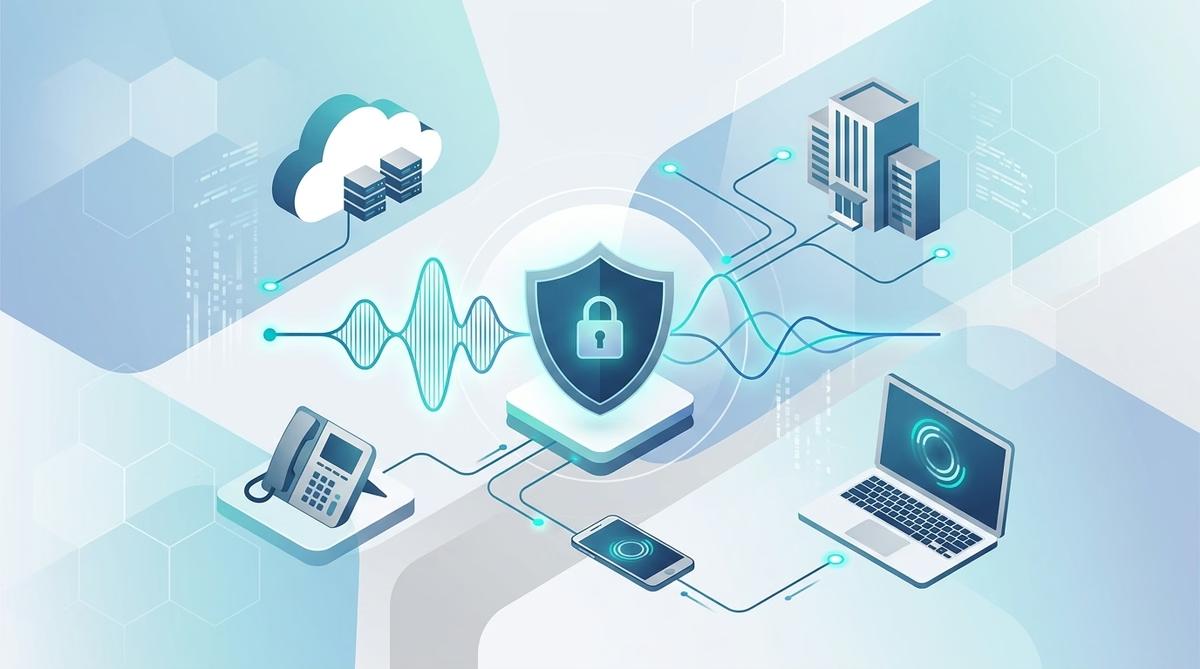
In an era where cyber threats are becoming increasingly sophisticated, traditional password-based authentication is no longer sufficient. For modern European businesses, the security of communication channels—specifically telephony—is paramount. As companies shift to cloud-based infrastructures with TheVoĉo, the need for a frictionless yet ironclad security layer has never been greater. Enter voice biometrics: an AI-powered solution that uses the unique characteristics of a human voice to verify identity.
Voice biometrics transforms your voice into a digital fingerprint. By analysing hundreds of vocal traits such as pitch, cadence, and breath patterns, this technology offers a robust alternative to static PINs or knowledge-based security questions, which are easily compromised by social engineering.
Enhancing Security Without Compromising User Experience
One of the primary challenges in corporate security is the friction it creates for employees and customers alike. Long, complex passwords often lead to 'password fatigue,' resulting in weak security choices. Voice biometrics changes this paradigm entirely.
- Passive Verification: Unlike active voice recognition that requires a specific passphrase, modern systems can authenticate users during natural conversation.
- Reduced Fraud Risk: It significantly mitigates the risk of identity theft and 'vishing' (voice phishing), which have become common threats to European financial and logistics sectors.
- Seamless Integration: By incorporating this into your cloud PBX, authentication happens in the background, allowing your team to focus on the conversation rather than the verification process.
For a busy support centre in Berlin or a financial firm in London, this means security is no longer an obstacle to efficiency but an integrated component of the workflow.
Compliance, GDPR, and Data Sovereignty
For any organisation operating within the European Economic Area (EEA), data protection is not just a feature—it is a legal mandate. The General Data Protection Regulation (GDPR) sets a high bar for the processing of 'biometric data' when used for the purpose of uniquely identifying a natural person.
At TheVoĉo, we understand that biometric data is sensitive. Implementing voice biometrics requires a privacy-by-design approach:
- Data Minimisation: Ensure that only the 'voiceprint' (a mathematical representation of the voice) is stored, not the actual audio recordings.
- Explicit Consent: Under GDPR, you must obtain informed, unambiguous consent from users before enrolling them in a biometric authentication programme.
- Data Sovereignty: By keeping your cloud infrastructure within EU-based data centres, you ensure that your biometric data remains subject to European judicial oversight, avoiding the pitfalls of trans-Atlantic data transfer complexities.
Operational Benefits for Global Businesses
While security is the primary driver, the operational benefits are equally compelling. Managing password resets is one of the highest volume tickets for IT departments. By moving to a biometric model, businesses can:
- Lower IT Costs: Dramatically reduce the administrative burden associated with password resets and compromised account recovery.
- Accelerate Service Delivery: Customers no longer need to answer 'security questions' about their mother's maiden name or childhood pet, allowing for faster resolution of inquiries.
- Scalability: Whether you have a team of 50 or 5,000, cloud-based voice authentication scales effortlessly without needing new hardware.
Consider a multinational firm managing remote teams across different time zones. With voice biometrics, a staff member in Paris can securely access corporate systems regardless of their location, provided their voice profile is enrolled in the central, secure database.
Implementing Secure Voice Solutions
Transitioning to voice biometrics requires careful planning. Start by identifying high-risk areas in your current workflow where verification is mandatory. Once identified, integrate the solution through an API-first approach that connects directly to your existing CRM and VoIP platform.
Actionable steps for your IT team:
- Conduct a Data Protection Impact Assessment (DPIA): Essential for compliance when implementing biometric technology.
- Choose a Reliable Partner: Ensure your VoIP provider uses state-of-the-art encryption both in transit and at rest.
- Educate Your Workforce: Transparency builds trust. Explain to your employees how their biometric data is protected and why it makes their daily work more secure.
Conclusion: The Path Forward
The move toward voice biometrics represents a significant leap forward in corporate security. As businesses continue to embrace digital transformation, the tools we use must be as agile as they are secure. By choosing an expert partner like TheVoĉo, your organisation can leverage cutting-edge AI to protect its most sensitive interactions.
Ready to elevate your business communication security? Contact the TheVoĉo security team today to discuss how we can integrate advanced biometric authentication into your existing infrastructure.