
SIP REGISTER is a fundamental Session Initiation Protocol (SIP) method used by User Agents (UAs) to inform a SIP Registrar server of their current location. It establishes a 'binding' between a user's Address-of-Record (AoR) – essentially their identity – and their current contact address (IP address and port), allowing other SIP entities to route calls and messages to them.In the world of VoIP, users aren't always in a fixed location. A softphone might run on a laptop moving between Wi-Fi networks, a desk phone might be provisioned with a dynamic IP address, or a user might have multiple devices. Without a mechanism to track these dynamic locations, how would a SIP server know where to send an incoming call for '[email protected]'?This is precisely the problem SIP REGISTER solves. It provides a dynamic mapping service. Instead of a static configuration, users 'register' their current whereabouts, allowing the SIP proxy to find them reliably. This ensures reachability, even as network conditions or device locations change. It's the equivalent of a mobile phone updating its location with the cellular network – essential for call delivery.The SIP REGISTER process involves a few key steps, primarily between a User Agent Client (UAC) and a SIP Registrar:1. Initial REGISTER Request: A SIP phone (UAC) sends a REGISTER request to its configured SIP Registrar. This request typically includes: * To header: The user's Address-of-Record (AoR), e.g., sip:[email protected]. * From header: Usually the same as To. * Contact header: The IP address and port where the UAC is currently listening for incoming SIP messages. This is the crucial piece of information for the binding. * Expires header: Specifies how long the registration is valid, typically in seconds (e.g., Expires: 3600 for one hour). If not renewed, the binding will expire. Example initial REGISTER without authentication:REGISTER sip:example.com SIP/2.0Via: SIP/2.0/UDP 192.168.1.100:5060;branch=z9hG4bK-abcdeMax-Forwards: 70To: <sip:[email protected]>From: <sip:[email protected]>;tag=12345Call-ID: [email protected]: 1 REGISTERContact: <sip:[email protected]:5060>Expires: 3600Content-Length: 02
. Authentication Challenge (401/407): For security, most SIP registrars require authentication. Upon receiving an initial REGISTER without credentials, the registrar typically responds with: * 401 Unauthorized: If the request originated from the domain itself (e.g., an internal proxy). * 407 Proxy Authentication Required: If the request came via an outbound proxy. Both responses include a WWW-Authenticate (for 401) or Proxy-Authenticate (for 407) header. This header specifies the authentication realm and challenge (e.g., Digest authentication, nonce). Example 401 Unauthorized response:SIP /2.0 401 UnauthorizedVia: SIP/2.0/UDP 192.168.1.100:5060;branch=z9hG4bK-abcdeFrom: <sip:[email protected]>;tag=12345To: <sip:[email protected]>;tag=67890Call-ID: [email protected]: 1 REGISTERWWW-Authenticate: Digest realm="example.com", nonce="aGVsbG8gd29ybGQ="Content-Length: 0
This step is crucial for sip authentication.3. Authenticated REGISTER Request: The UAC, upon receiving the challenge, computes a response using the user's username and password, along with the provided nonce and other details. It then resends the REGISTER request, this time including an Authorization (or Proxy-Authorization) header. Example authenticated REGISTER request:REGISTER sip:example.com SIP/2.0Via: SIP/2.0/UDP 192.168.1.100:5060;branch=z9hG4bK-fghijMax-Forwards: 70To: <sip:[email protected]>From: <sip:[email protected]>;tag=12345Call-ID: [email protected]: 2 REGISTERContact: <sip:[email protected]:5060>Expires: 3600Authorization: Digest username="bob", realm="example.com", nonce="aGVsbG8gd29ybGQ=", uri="sip:example.com", response="d3b5d2d0c2c1a1a2b3b4c5c6d7d8e9e0", algorithm=MD5Content-Length: 04
. Successful Registration (200 OK): If the credentials are valid, the Registrar processes the request and stores the contact binding (AoR to Contact URI mapping) in its location service. It then responds with a 200 OK. The Contact header in the 200 OK response often reflects the received Contact header from the UAC, and crucially, its Expires value. Example 200 OK response:SIP /2.0 200 OKVia: SIP/2.0/UDP 192.168.1.100:5060;branch=z9hG4bK-fghijFrom: <sip:[email protected]>;tag=12345To: <sip:[email protected]>;tag=67890Call-ID: [email protected]: 2 REGISTERContact: <sip:[email protected]:5060>;expires=3600Content-Length: 0
The registration is now active for the duration specified by Expires. The UAC is expected to refresh this registration before it expires to maintain reachability.mermaidsequenceDiagram participant UA as User Agent (Phone) participant REG as SIP Registrar UA->>REG: REGISTER sip:domain.com (No Auth) REG-->>UA: 401 Unauthorized (Challenge) UA->>REG: REGISTER sip:domain.com (With Authorization) REG-->>UA: 200 OK (Registration Success)Understanding
common SIP REGISTER issues can save significant troubleshooting time for telecom engineers and developers. Incorrect Credentials: This is the most frequent issue. A wrong username, password, or authentication realm will lead to repeated 401 Unauthorized or 407 Proxy Authentication Required responses without a successful 200 OK. Check user details on both the client and server.* NAT/Firewall Issues: SIP devices behind Network Address Translators (NAT) or firewalls can struggle to register. The Contact header might contain a private IP address that's unreachable from the registrar. Solutions include STUN/TURN servers, rport in Via header, or SIP ALG (though often problematic). The registrar might send a 200 OK but subsequent calls fail because the registrar can't reach the Contact URI.* Expired Registrations: If the UAC fails to refresh its registration before the Expires time, the binding will be removed. This leads to incoming calls failing until the client re-registers. Many clients automatically re-register at half or two-thirds of the Expires interval. A high Expires value (e.g., 3600 seconds/1 hour) reduces network traffic but increases the time for the network to detect an unreachable device; a low value (e.g., 60-120 seconds) is more responsive but chattier. SIP URI Mismatch: Ensure the To header and the domain in the REGISTER request URI match what the registrar expects. Sometimes, a UAC might try to register with sip:[email protected] when the registrar expects sip:[email protected]. Incorrect Registrar Address: The phone might be configured to send REGISTER requests to the wrong IP address or hostname, leading to no response or SIP/2.0 503 Service Unavailable if it reaches an incorrect SIP server.* CSeq Issues: While less common, out-of-order CSeq values can sometimes confuse a registrar, though robust implementations handle this well. For a re-REGISTER, the CSeq should increment.* Unsupported Authentication Method: The WWW-Authenticate header specifies the challenge. If the client doesn't support the requested authentication scheme (e.g., Digest when it only supports Basic), registration will fail. Digest is the most common.Debugging these issues often involves capturing SIP traces (e.g., with Wireshark) to examine the message exchange between the client and the registrar.To further your understanding of SIP, explore these related topics: SIP Methods Explained: Dive deeper into the various SIP request methods beyond REGISTER.* SIP Response Codes: Get a comprehensive overview of the different responses a SIP server can send, like 200 OK, 401 Unauthorized, and 503 Service Unavailable.* Top SIP Errors: Learn about other common issues you might encounter in SIP deployments and how to troubleshoot them.
Platform
SIP REGISTER Explained
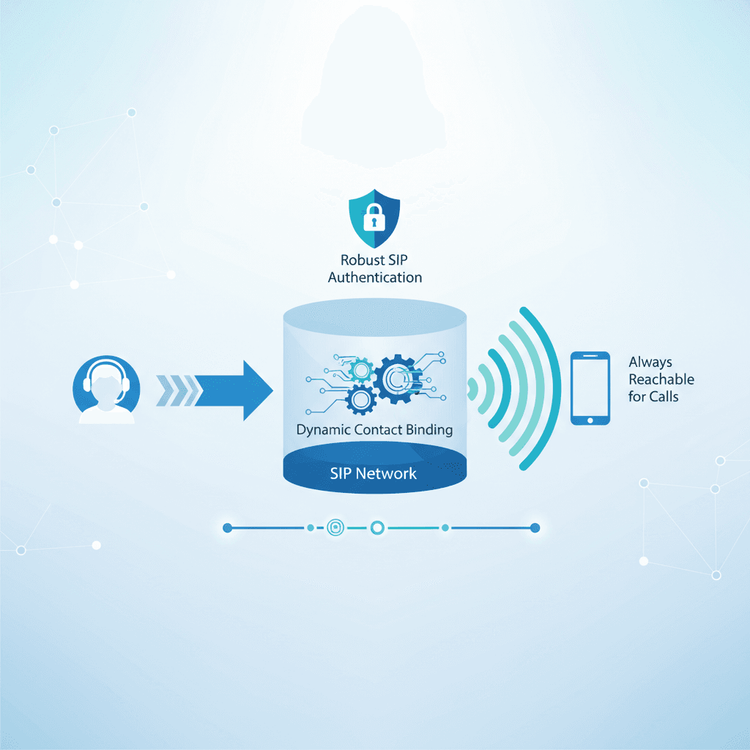
Unpack SIP REGISTER, the core mechanism for users to signal their location to a SIP network. Learn how it facilitates dynamic contact binding, enables robust SIP authentication, and ensures you're always reachable for calls.

Product Team
•5 min read
Tags:sipregistervoipauthenticationbinding