

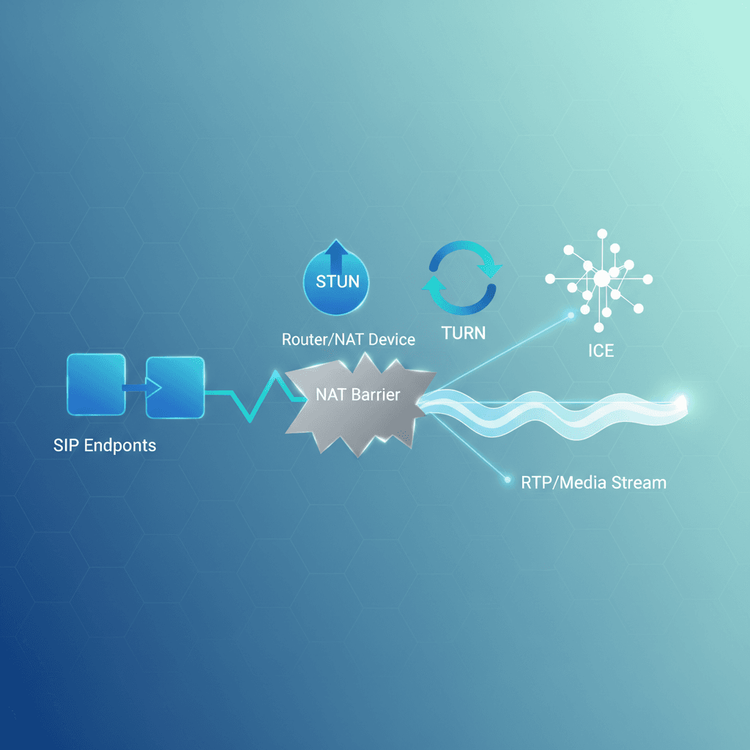
Network Address Translation (NAT) is ubiquitous in modern networks, allowing multiple devices on a private network to share a single public IP address. While beneficial for conserving IP addresses and enhancing security, NAT poses significant challenges for real-time communication protocols like Session Initiation Protocol (SIP) and Real-time Transport Protocol (RTP). SIP NAT traversal refers to the set of techniques and protocols—primarily STUN, TURN, and ICE—designed to enable SIP and RTP traffic to successfully navigate NAT devices, ensuring clear and reliable VoIP calls.
Why NAT Breaks SIP/RTP and What Problem It Solves
Imagine two VoIP phones, Phone A and Phone B, trying to establish a call. If both are on private networks behind NAT devices, they can't directly communicate using their private IP addresses. NAT works by rewriting the source IP and port of outgoing packets and maintaining a mapping table. When a packet from a public IP arrives, NAT uses this mapping to forward it to the correct private IP and port. The problem for SIP/RTP arises because:
- IP Address in SIP Headers: SIP messages (specifically the
Via,Contact, andRecord-Routeheaders) contain IP addresses. If a phone behind NAT inserts its private IP into these headers, the other party (or the SIP proxy) will try to send packets to an unreachable private IP. - IP Address in SDP (Session Description Protocol): The media description within SIP's body (SDP) specifies the IP address and port (
c=line) where RTP media should be sent. Again, if this is a private IP, direct media flow is impossible. - Inbound Connections: For VoIP calls, both sides need to be able to send and receive data. NAT typically allows outgoing connections but blocks unsolicited incoming connections to private IPs, preventing RTP streams from reaching the intended phone.
- Symmetric NAT: The most restrictive NAT type, Symmetric NAT, maps each new outgoing connection from a private IP:Port to a new public IP:Port. This makes it extremely difficult for an external party to guess the correct mapping to send data back.
These issues prevent successful SIP signaling and, crucially, media (voice/video) exchange, leading to one-way audio, no audio, or failed calls. SIP NAT traversal protocols solve this by helping endpoints discover their public IP and port mappings or by relaying traffic when direct connections aren't possible.
How It Works: STUN, TURN, and ICE
These three protocols work together as a robust solution for NAT traversal.
STUN (Session Traversal Utilities for NAT)
STUN is the simplest and first line of defense. A STUN client (your VoIP phone or softphone) sends a request to a public STUN server. The STUN server replies, telling the client its public IP address and port as seen from the server's perspective. The client then uses this discovered public IP:Port in its SIP messages and SDP to inform the remote party where to send RTP media.
- How it helps: Reveals the public IP and port, useful for Full Cone, Restricted Cone, and Port Restricted Cone NATs.
- Limitations: It cannot help with Symmetric NAT because the public mapping changes for each new destination. It also doesn't relay media.
TURN (Traversal Using Relays around NAT)
When STUN fails (e.g., with Symmetric NAT or when firewalls are too restrictive), TURN comes to the rescue. A TURN server acts as a relay for media traffic. Instead of sending media directly to each other, both endpoints send their RTP packets to the TURN server, which then forwards them to the other endpoint. This effectively bypasses the NAT restrictions by making all connections appear as outgoing from the perspective of the NAT device.
- How it helps: Guarantees connectivity by relaying all media, even through Symmetric NATs.
- Limitations: Requires more bandwidth and processing power on the TURN server, adding latency. It's considered a last resort due to its overhead.
ICE (Interactive Connectivity Establishment)
ICE is a comprehensive framework that combines STUN and TURN to find the best possible communication path between two endpoints. It's not a protocol itself but an intelligent method for discovering, gathering, and testing multiple communication candidates (IP addresses and ports).
Here's the step-by-step process:
- Gather Candidates: Each endpoint gathers a list of potential IP:Port pairs it can use to communicate. These candidates fall into three types:
- Host Candidates: The endpoint's own private IP and port.
- Server Reflexive Candidates: Discovered by sending requests to a STUN server, revealing the public IP and port mapping.
- Relay Candidates: Obtained from a TURN server, which allocates a public IP and port on the TURN server itself for relaying traffic.
- Exchange Candidates: Endpoints exchange their lists of candidates via SIP's SDP. This is an extension to the standard SDP offer/answer model.
- Perform Connectivity Checks: Each endpoint attempts to establish connections to all the remote candidates, prioritizing host > server reflexive > relay. It sends STUN connectivity check messages (Binding Request) to test each path.
- Select Best Path: Based on the connectivity checks, endpoints determine the most efficient working path. If a direct host-to-host path works, great. If not, they try STUN-mapped addresses. If all else fails, they resort to the TURN relay.
This intelligent selection ensures that the most direct and efficient path is used whenever possible, only resorting to resource-intensive relaying when necessary.
Example: ICE Candidate Exchange in SDP
When ICE is used, the SDP body in an INVITE or 200 OK message will contain additional attributes like a=candidate for each gathered IP:Port pair. For instance:
INVITE sip:[email protected] SIP/2.0
Via: SIP/2.0/UDP 192.168.1.100:5060;branch=z9hG4bK-somenatid
Contact: <sip:[email protected]:5060>
Content-Type: application/sdp

v=0
o=alice 2890844526 2890844526 IN IP4 192.168.1.100
s=-
t=0 0
m=audio 5004 RTP/AVP 0
c=IN IP4 192.168.1.100
a=candidate:1 1 UDP 2130706431 192.168.1.100 5004 typ host
a=candidate:2 1 UDP 1686052607 203.0.113.42 12345 typ srflx raddr 192.168.1.100 rport 5004
a=candidate:3 1 UDP 1000000000 198.51.100.10 60000 typ relay raddr 192.168.1.100 rport 5004
In this SDP snippet, alice offers three candidates for her media stream:
typ host: Her private IP192.168.1.100.typ srflx: A server reflexive (STUN-discovered) candidate203.0.113.42:12345(her public IP:Port).typ relay: A relay (TURN-allocated) candidate198.51.100.10:60000on the TURN server.
The remote party (Bob) would similarly provide his candidates, and then they perform connectivity checks to find the best path. This process is integral to a complete SIP call flow explained when NAT is involved.
Diagram Hint: ICE Connectivity Check Sequence
sequenceDiagram
    participant Alice as Alice (Client A)
    participant Alice_NAT as Alice's NAT
    participant StunServer as STUN Server
    participant TurnServer as TURN Server
    participant Bob as Bob (Client B)

    Alice->>StunServer: Binding Request (discover public IP)
    StunServer-->>Alice: Binding Response (Alice's public IP:Port)

    Alice->>TurnServer: Allocate Request (get relay candidate)
    TurnServer-->>Alice: Allocate Response (Relay IP:Port on TURN)

    Alice->>Bob: INVITE (SDP with host, srflx, relay candidates)
    Bob->>Alice: 200 OK (SDP with host, srflx, relay candidates)

    Alice->>Bob: STUN Binding Request (Host-to-Host check)
    Bob-->>Alice: STUN Binding Response (if direct path works)

    Alice->>Bob: STUN Binding Request (STUN-to-STUN check via public IPs)
    Bob-->>Alice: STUN Binding Response (if public path works)

    Alice->>TurnServer: RTP (to Relay IP:Port)
    TurnServer->>Bob: RTP (from Relay IP:Port)
    Bob->>TurnServer: RTP (to Relay IP:Port)
    TurnServer->>Alice: RTP (from Relay IP:Port)
    Note right of TurnServer: If direct/STUN paths fail, media relays via TURN
Common Mistakes and Troubleshooting
Troubleshooting NAT traversal issues can be tricky. Here are common pitfalls and a checklist:
- Firewall Blockages: Often, corporate or home firewalls block necessary UDP ports for STUN, TURN, or RTP. Ensure ports are open, especially for TURN (typically UDP 3478, TCP 3478 for signaling; RTP range dynamically allocated).
- Misconfigured STUN/TURN Servers: Incorrect server addresses, authentication failures, or unavailable servers will lead to ICE failure. Verify server configuration and network reachability.
- SIP ALG (Application Layer Gateway) Issues: Many routers have SIP ALGs that try to
"fix"SIP messages by rewriting IP addresses in headers and SDP. These often break more than they fix, especially with secure SIP (TLS/SRTP) or complex NAT scenarios. Disable SIP ALG whenever possible. - Incorrect SDP in Offer/Answer: If the SDP isn't correctly constructed with ICE candidates or if an endpoint doesn't support ICE, connectivity will fail. Ensure SDP offer/answer adheres to ICE specifications.
- Symmetric NAT without TURN: If an endpoint is behind a Symmetric NAT and only STUN is configured, it will fail to establish a direct connection. TURN is essential in these scenarios.
- Insufficient Bandwidth for TURN: While TURN ensures connectivity, it adds overhead. If an endpoint's internet connection is slow, relaying all media can degrade quality. For considerations on media encryption, refer to RTP vs SRTP.
Troubleshooting Checklist:
- Verify STUN/TURN Server Reachability: Can your client reach the configured STUN/TURN server IPs and ports?
- Check Firewall Rules: Are UDP ports 3478 (STUN/TURN control) and the RTP port range open on your local and network firewalls?
- Disable SIP ALG: Access your router settings and disable any SIP ALG features.
- Inspect SIP/SDP Traces: Use tools like Wireshark to capture SIP and SDP messages. Look for
Via,Contact,c=, anda=candidatelines to see which IPs are being advertised. - Test with Different NAT Types: If possible, test your setup behind different NAT configurations to isolate the problem.
- Review Server Logs: Check STUN/TURN server logs for errors or connectivity issues.
Related Terms (Internal Links)
- RTP vs SRTP: Understanding the media transport and security aspects.
- SIP call flow explained: A deeper dive into the overall SIP signaling process.
- SDP offer/answer: Details on how media capabilities are exchanged.
By understanding the roles of STUN, TURN, and ICE, and armed with a systematic troubleshooting approach, VoIP/telecom engineers, developers, and operations teams can effectively conquer NAT challenges and deliver robust real-time communication experiences.