

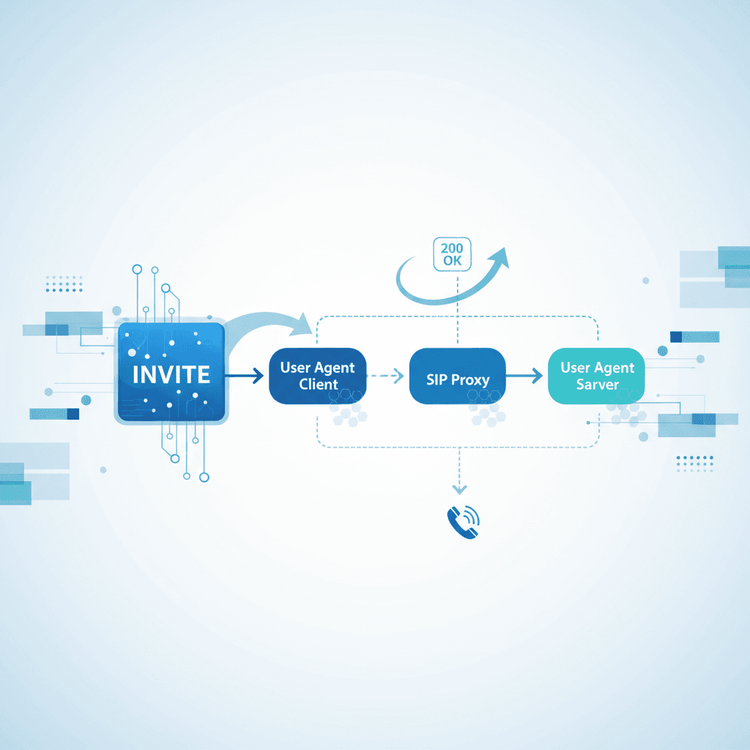
The SIP INVITE method is the fundamental request used to initiate a multimedia session, such as a voice or video call, within the Session Initiation Protocol. It signals an intention to establish communication, carrying session description information (SDP) that details the media capabilities and parameters for the proposed connection. It's the "hello, I want to talk" message in SIP.
Before SIP, establishing real-time communication sessions involved complex, often proprietary, signaling systems. The SIP INVITE method was designed to standardize and simplify call initiation across diverse IP networks. It solves the problem of interoperability by providing a unified way for VoIP endpoints and servers to negotiate and establish sessions. By carrying participant addresses, session type, and media codecs, INVITE enables universal communication setup, caller ID, call routing, and media negotiation, crucial for modern unified communications.
The SIP INVITE method kicks off the intricate sip call flow for establishing a communication session. Here's a typical sequence:
- Initiation: A User Agent Client (UAC), like your VoIP phone, sends a
SIP INVITEsip requestto a SIP Proxy Server (or directly to another User Agent Server, UAS). This INVITE contains critical information about the proposed call. - Proxying/Routing: If sent to a proxy, it forwards the INVITE, potentially through several other proxies, until it reaches the intended UAS.
- Ringing Indication (180 Ringing): The UAS, upon receiving the INVITE and determining availability, typically sends a
180 Ringingprovisional response. This informs the calling party that the callee's phone is ringing. Other responses like100 Tryingor183 Session Progress(with early media) might precede this. - Callee Accepts (200 OK): When the callee answers, the UAS sends a
200 OKfinal response. This confirms the callee is ready. If the INVITE contained an SDP offer, the200 OKwill contain the callee's SDP answer. - Caller Acknowledges (ACK): The original UAC then sends an
ACK(Acknowledgement) message. This finalizes the handshake, confirming receipt of the200 OK, and signaling that media exchange can begin. - Media Exchange: After the ACK, media (voice, video) flows directly between the UAC and UAS (peer-to-peer) or via a media server, based on the negotiated SDP.
Understanding the SIP INVITE means knowing its key headers, crucial for routing, managing, and identifying the session.
From: Identifies the request initiator. Contains the caller's SIP URI and atagparameter.From: "Alice" <sip:[email protected]>;tag=9fxced76sl
To: Identifies the intended recipient. Contains the callee's SIP URI. Atagis added by the UAS in the200 OK.To: "Bob" <sip:[email protected]>
Via: Records the path taken by thesip request. Each SIP entity forwarding the message adds its own address, essential for routing responses back.Via: SIP/2.0/UDP pc33.example.com;branch=z9hG4bK776asdhds
Contact: Indicates the direct URI where the User Agent (UA) can be reached for subsequent requests.Contact: <sip:[email protected]:5060>
Call-ID: A unique identifier for a specificsip call flow. All messages for the same call share this ID.Call-ID: 2f7a9g8j0h9f8d7s6a
CSeq(Command Sequence): A decimal number and method name (e.g.,INVITE). Orders transactions, ensuring reliable delivery. Increments for each new request.CSeq: 1 INVITE
The SIP INVITE typically carries a Session Description Protocol (SDP) payload, describing media characteristics like codecs, IP addresses, and ports.
- INVITE with SDP (Offer): Most common. The UAC sends an INVITE with its proposed media capabilities (an SDP "offer"). The UAS responds with a
200 OKcontaining its chosen capabilities (an SDP "answer"), following the SDP Offer/Answer model.- Example SDP offer in INVITE body:
v=0
        o=alice 2890844526 2890844526 IN IP4 192.0.2.4
        s=SIP Call
        c=IN IP4 192.0.2.4
        t=0 0
        m=audio 5004 RTP/AVP 0 8 101
        a=rtpmap:0 PCMU/8000
        a=rtpmap:8 PCMA/8000
        a=rtpmap:101 telephone-event/8000
        a=fmtp:101 0-16
        a=sendrecv
- INVITE without SDP: Less common. The INVITE is purely a setup
sip request. The UAS might send an SDP offer in a provisional response (183 Session Progress) or200 OK, and the UAC would respond with anACKcontaining its SDP answer ("delayed offer").
Often, before a SIP INVITE can be successfully processed, the calling party needs to authenticate with the SIP server. This is handled through a challenge-response mechanism:
- INVITE (unauthenticated): The UAC sends an initial
SIP INVITE. 401 Unauthorizedor407 Proxy Authentication Required: The SIP server (either a Registrar/Proxy or an Outbound Proxy) rejects the INVITE with one of thesesip response codes. It includes aWWW-Authenticate(for401) orProxy-Authenticate(for407) header, specifying the authentication scheme (e.g., Digest) and anoncevalue.SIP/2.0 401 UnauthorizedWWW-Authenticate: Digest realm="voicemail.example.com", nonce="dcd98b7102ddb493ad5ce556c071d3c2", qop="auth"
- INVITE (authenticated): The UAC, having received the challenge, re-sends the original
SIP INVITEbut now includes anAuthorization(for401) orProxy-Authorization(for407) header. This header contains the username, password hash,nonce, and other parameters required to prove its identity. - Success: If authentication is successful, the server then processes the INVITE normally.
Let's visualize a simplified sip call flow for a successful call using a Mermaid sequence diagram.
sequenceDiagram
    participant UAC as Caller (UA Client)
    participant Proxy as SIP Proxy Server
    participant UAS as Callee (UA Server)

    UAC->>Proxy: F1 INVITE (SDP Offer)
    Proxy->>UAS: F2 INVITE (SDP Offer)
    UAS-->>UAC: F3 180 Ringing (via Proxy)
    UAS-->>UAC: F4 200 OK (SDP Answer, via Proxy)
    UAC->>UAS: F5 ACK (via Proxy)
    Note over UAC,UAS: Media (RTP) Flow
Several issues can derail a SIP INVITE initiated call:
- NAT Traversal: A widespread problem. UACs behind NATs have private IPs in
Contactand SDP, making them unreachable externally. Solutions include STUN/TURN/ICE or SIP-aware proxies (SBCs). Misconfigured NAT often causes one-way or no audio. - SDP Mismatch: If the SDP offer/answer disagree on codecs, media types, or transport, the call connects without media or with poor quality. Debug by checking
INVITEand200 OKfor SDP payloads. - Firewall Blocks: SIP (5060 UDP/TCP) and RTP media ports (e.g., 10000-20000 UDP) must be open bi-directionally. Firewalls can silently drop
SIP INVITEs or media. - Authentication Failures: Incorrect credentials or realm configs lead to
401 Unauthorizedor407 Proxy Authentication Requiredresponses, preventing call setup. Logs clearly show thesesip response codes. - Registration Issues: If a callee's phone isn't registered, the
INVITEcan't locate the target, resulting in404 Not Found. - CSeq Issues: While less common in basic flows, incorrect
CSeqhandling in complex scenarios can cause transaction failures or messages to be ignored;CSeqvalues must increment.
To deepen your understanding of SIP, explore these related concepts:
- SIP Call Flow Explained: For a broader view of a complete call lifecycle, including termination, check out our detailed guide on /blog/sip-call-flow-explained.
- SDP Offer/Answer Model: Dive deeper into how media capabilities are negotiated between endpoints with our article on the /blog/sdp-offer-answer.
- SIP Response Codes: Understand the various signals SIP entities use to communicate status and errors by reviewing /blog/sip-response-codes.
- SIP Register: Learn how endpoints announce their availability to a SIP network through the
REGISTERmethod. - SIP REFER: Discover how calls can be transferred by one party telling another to establish a new call.