The Evolution of International Communication
In the modern business landscape, the borders that once defined commerce have largely dissolved. A small boutique agency in Amsterdam can effortlessly manage clients in New York, while a manufacturing firm in Munich coordinates daily with suppliers in Shenzhen. However, as business has globalised, the underlying infrastructure used to facilitate these connections has undergone a radical transformation. For decades, traditional carriers held a monopoly on international voice traffic, but the rise of Voice over Internet Protocol (IP) has fundamentally challenged the status quo.
For European business owners and IT professionals, choosing between a traditional carrier and a VoIP provider is no longer just a technical decision; it is a strategic one. This choice impacts operational costs, call quality, and the ability to scale in a competitive market. In this guide, we will explore the nuances of both systems, specifically through the lens of European business requirements, to help you determine which solution best serves your international ambitions.
The Legacy of Traditional Carriers: PSTN and ISDN
Traditional international calling relies on the Public Switched Telephone Network (PSTN), a global circuit-switched network that has been the backbone of telephony for over a century. In Europe, many businesses still operate on Integrated Services Digital Network (ISDN) lines, which were once the pinnacle of digital communication. However, the era of the copper-wire landline is rapidly drawing to a close.
Major European telecommunications providers, such as BT in the United Kingdom, Deutsche Telekom in Germany, and Orange in France, are in the final stages of phasing out legacy PSTN and ISDN services in favour of all-IP networks. Traditional carriers offer a high degree of reliability because they use dedicated physical circuits for each call. When you dial an international number, a specific path is reserved for your conversation, ensuring consistent audio quality.
However, this reliability comes at a steep price. International calls via traditional carriers are notoriously expensive because they involve multiple 'transit' providers across different countries, each taking a cut of the fee. Furthermore, traditional systems are rigid. Adding a new international line often requires physical hardware installation and long lead times, which can hinder an organisation's ability to respond to new market opportunities.
The Rise of VoIP for Global Business
VoIP technology represents a paradigm shift by converting voice signals into digital data packets and transmitting them over the internet. Unlike traditional telephony, VoIP does not require a dedicated physical circuit. This flexibility is the primary reason why cloud-based systems like TheVoĉo have become the preferred choice for forward-thinking European enterprises.
One of the most significant advantages of VoIP is the concept of 'location independence'. With a cloud-based PBX, your business is not tied to a physical office in a specific city. You can assign virtual international numbers to your team, allowing a representative in Madrid to answer calls from a local London (+44) or Dublin (+353) number. This local presence is invaluable for building trust with international clients, as customers are far more likely to answer and engage with a local number than an unfamiliar foreign one.
Moreover, VoIP integrates seamlessly with modern business tools. Whether it is synchronising call logs with a CRM or using AI-powered transcription for international board meetings, VoIP transforms the desk phone from a simple audio device into a powerful data hub.
Cost Comparison: Per-Minute vs. Subscription Models
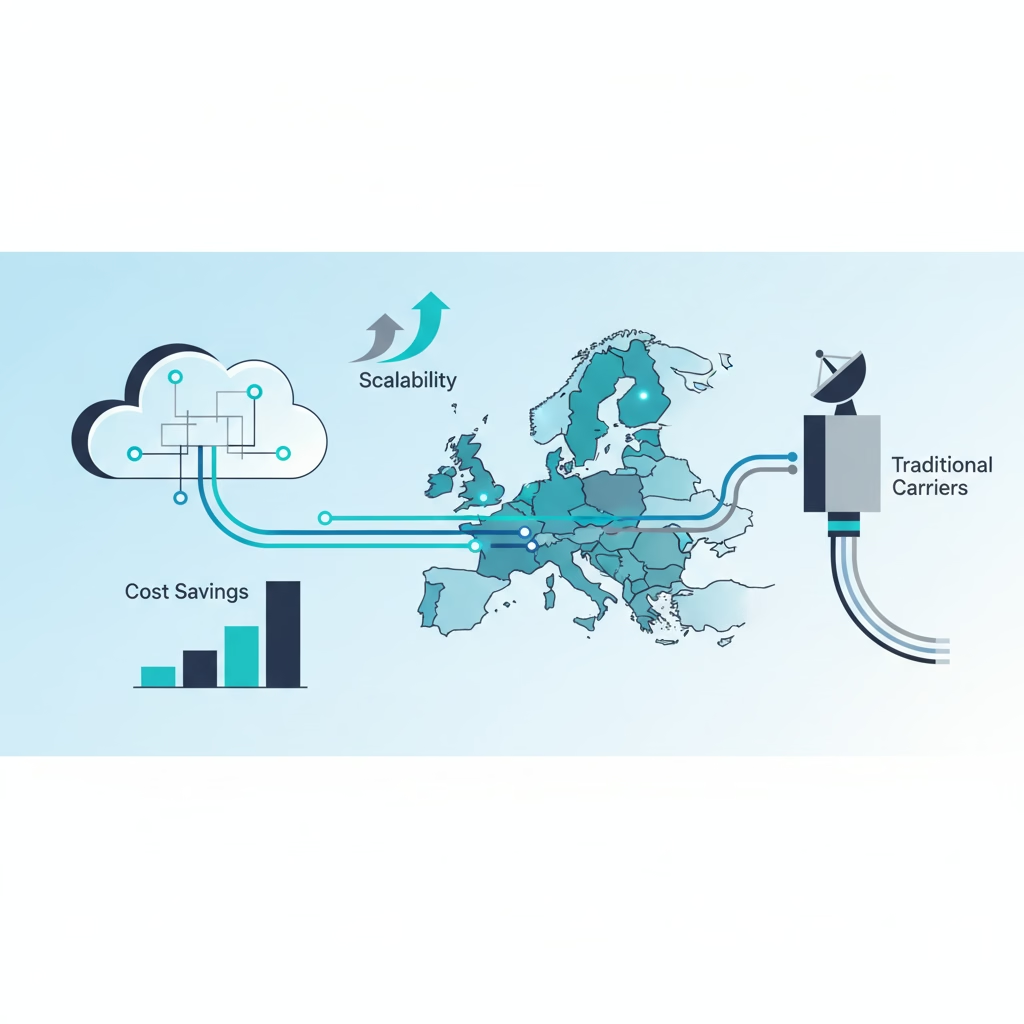
When comparing the financial impact of VoIP versus traditional carriers, the differences are stark. Traditional carriers typically charge high per-minute rates for international calls, which can fluctuate based on the destination country and the time of day. For a European company with heavy call volumes to North America or Asia, these costs can quickly become a significant overhead.
VoIP providers, conversely, usually offer more transparent pricing structures. Many platforms provide monthly subscription tiers that include a set number of international minutes or even unlimited calling to specific zones (such as the EU/EEA and North America). Because VoIP traffic travels over the public internet or private data networks, the incremental cost of sending data to another continent is negligible compared to the cost of maintaining physical switching equipment.
Actionable Advice for Cost Savings:
- Audit your call logs: Identify which international regions your team calls most frequently.
- Leverage internal calls: With VoIP, calls between your company's global offices (e.g., London to Paris) are typically free, as they remain within the same data network.
- Monitor 'Off-Peak' usage: While VoIP is generally cheaper, some providers offer even lower rates for data transmission during non-business hours in specific time zones.
Quality and Technical Considerations
A common misconception is that VoIP quality is inferior to traditional landlines. While this may have been true in the early 2000s, the rollout of high-speed fibre broadband across Europe has changed the equation. Modern VoIP uses High-Definition (HD) voice codecs (like G.722) that provide a broader frequency range than traditional telephony, resulting in clearer, more natural-sounding conversations.
However, VoIP performance is heavily dependent on your internet connection. For European businesses, this means ensuring that your office network is optimised for voice traffic. Implementing Quality of Service (QoS) settings on your router can prioritise voice packets over other data-heavy tasks, like software updates or video streaming, ensuring that international calls remain jitter-free.
Another technical advantage of VoIP is the ease of managing time zones. Advanced routing features allow European organisations to automatically redirect calls based on the time of day. For instance, an after-hours call to your Berlin office can be seamlessly routed to a partner team in New York or a support centre in Singapore, ensuring 24/7 global availability without the need for expensive international call forwarding fees.
The Security and Compliance Landscape
For any European organisation, data protection is a non-negotiable priority. Under the General Data Protection Regulation (GDPR), businesses must ensure that any communication system they use to process personal data is secure and compliant.
When using VoIP for international calling, it is essential to choose a provider that prioritises data sovereignty and encryption. Traditional phone lines are relatively easy to intercept with physical access. In contrast, modern VoIP systems use Transport Layer Security (TLS) and Secure Real-time Transport Protocol (SRTP) to encrypt voice data as it travels across the globe. When discussing international calls that may involve sensitive client information, having this layer of digital security is a significant advantage over legacy carriers.
Conclusion: Making the Right Choice
While traditional carriers still offer a sense of familiarity, the transition to VoIP is no longer a matter of 'if', but 'when'. For European businesses looking to expand their global footprint, VoIP provides a level of agility, cost-efficiency, and feature-richness that traditional PSTN or ISDN lines simply cannot match. By adopting a cloud-based phone system, your organisation can reduce international overheads, present a local face to global customers, and ensure your communications are ready for the digital future.
If you are ready to modernise your international communication strategy, explore how TheVoĉo's Cloud PBX can transform your business connectivity. Contact our team today for a tailored consultation.