
Introduction: The Edge of Voice Communication
In today's fast-paced business landscape, clear, reliable, and instantaneous voice communication is non-negotiable. Businesses across Europe and beyond are increasingly adopting Cloud PBX and VoIP solutions for their flexibility and cost-efficiency. However, as demand for real-time communication intensifies, so does the pressure on traditional cloud infrastructure to deliver flawless performance. This is where Edge computing emerges as a game-changer, promising to revolutionise how we experience voice applications.
At TheVoĉo, we understand the critical role high-quality telecommunications plays in your organisation's success. Edge computing complements our cloud-based offerings by bringing processing power closer to the user, tackling latency issues, and enhancing the overall voice experience. Let's delve into what Edge computing means for your business voice applications.
What is Edge Computing and Why Does it Matter for Voice?
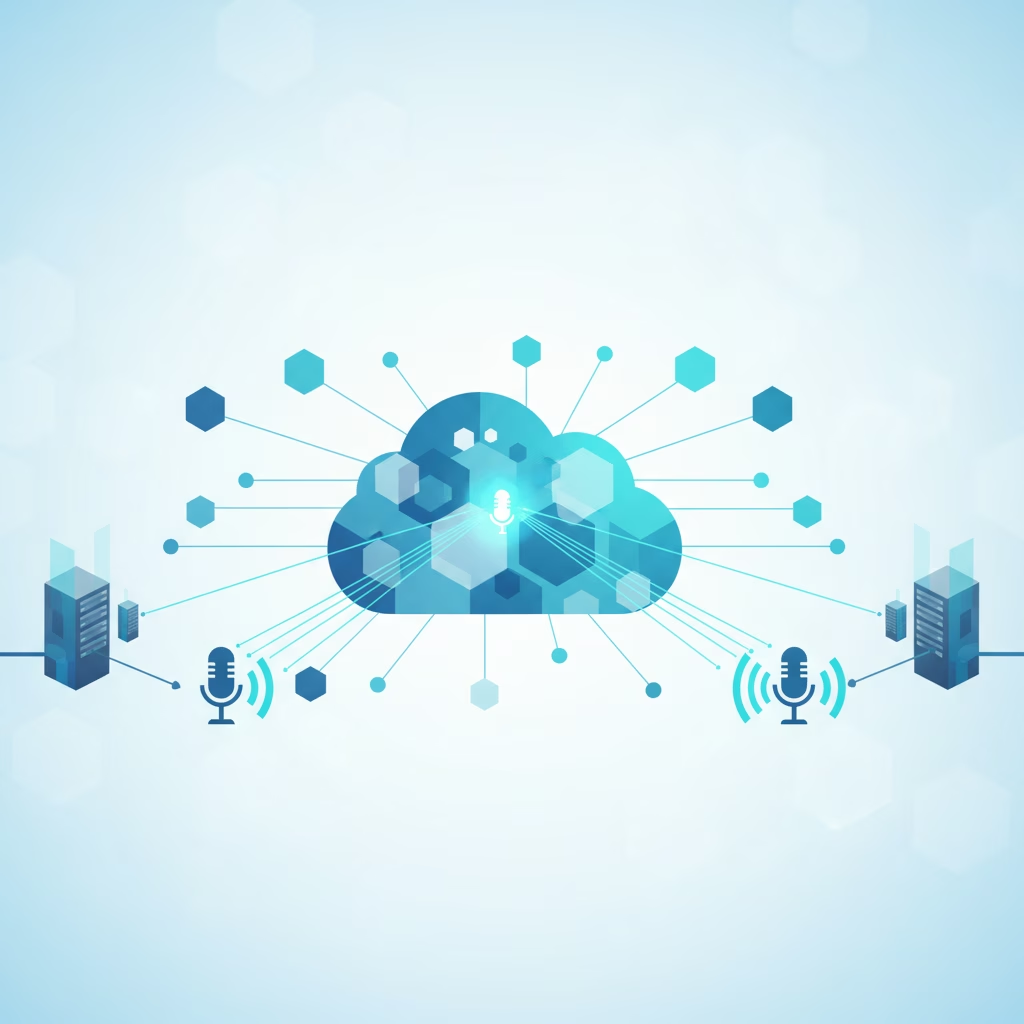
Edge computing is a distributed computing paradigm that brings computation and data storage closer to the sources of data. Instead of sending all data to a central data centre (the traditional cloud) for processing, Edge computing enables processing to happen at the 'edge' of the network – think local servers, IoT devices, or even within your own office network infrastructure. This significantly reduces the physical distance data has to travel.
For voice applications, this proximity is paramount. VoIP and other real-time communication tools are highly sensitive to latency – the delay before a transfer of data begins following an instruction for its transfer. Even milliseconds of delay can degrade call quality, introduce echo, or cause disruptions in video conferences. By processing voice data closer to where it originates and is consumed, Edge computing can dramatically mitigate these issues, leading to a smoother, more natural conversation flow.
Key Benefits of Edge Computing for Business Voice Applications
Embracing an Edge-enhanced approach to voice applications offers a multitude of benefits for modern businesses:
Reduced Latency and Improved Call Quality: This is the most direct and impactful benefit. By localising data processing, the time taken for voice packets to travel to and from a server is minimised. This translates directly into crystal-clear calls, seamless video conferencing, and instantaneous responses from interactive voice response (IVR) systems. For European businesses spanning multiple countries and time zones, this consistency in quality is invaluable.
Enhanced Reliability and Business Continuity: Relying solely on a central cloud can introduce a single point of failure. Edge computing decentralises processing, meaning that even if there's a temporary disruption to the wider internet or a central cloud facility, local voice services can potentially remain operational. This provides an additional layer of resilience, crucial for mission-critical communications.
Improved Security and Data Sovereignty: Processing sensitive voice data at the edge can provide enhanced security. By keeping data within local network boundaries or regional edge nodes, organisations can exert greater control over their information. This is particularly important for European businesses adhering to stringent regulations like GDPR, which mandates strict control over personal data. Edge solutions can help maintain data sovereignty by ensuring that voice recordings, call metadata, and other sensitive information remain within specified geographical jurisdictions or even on-premise, reducing the need to transmit all data across borders to distant cloud servers.
Optimised Bandwidth Usage: Sending all raw voice data to the central cloud consumes considerable bandwidth. Edge computing allows for initial processing and filtering of data locally, sending only aggregated or essential data to the central cloud. This can lead to significant bandwidth savings, especially for organisations with numerous branch offices or those in regions with limited internet infrastructure.
Faster AI and Analytics at the Edge: Modern voice applications increasingly integrate AI for tasks like real-time transcription, sentiment analysis, and voice authentication. Performing these computationally intensive tasks at the edge allows for immediate insights and faster responses, rather than waiting for data to travel to a distant cloud, be processed, and then returned. Imagine real-time language translation or fraud detection happening almost instantly during a call.
Practical Applications and Scenarios for European Businesses
Edge computing for voice is not just theoretical; it's already enabling practical enhancements across various sectors:
- Retail and Branch Offices: A retail chain with multiple stores across different European cities can use edge devices to manage local VoIP phone systems. This ensures that internal calls within a store are processed locally, maintaining high quality even during peak network usage, while still connecting seamlessly to the central cloud for broader communication.
- Manufacturing and Industrial IoT: In a factory setting, low-latency voice communication is vital for safety and operational efficiency. Edge computing can power intercom systems, push-to-talk solutions, and even voice-activated commands for machinery, ensuring immediate response times without reliance on distant servers.
- Healthcare Facilities: Hospitals and clinics can leverage edge computing to ensure secure, low-latency communication between medical staff. Voice data, especially sensitive patient information, can be processed and stored on edge servers within the hospital's network, enhancing security and compliance with strict data protection regulations like GDPR, while still allowing for cloud-based unified communications.
- Emergency Services: For first responders, reliable and immediate communication is literally a matter of life and death. Edge computing can support robust, localised communication networks that can function even under challenging conditions, ensuring critical voice traffic is prioritised and processed with minimal delay.
TheVoĉo's Approach to Edge-Enhanced Voice
At TheVoĉo, we are continually evolving our Cloud PBX and VoIP solutions to integrate the benefits of cutting-edge technologies. Our platform is designed to be flexible, scalable, and secure, and we recognise the pivotal role Edge computing plays in the future of telecommunications. By strategically deploying edge capabilities, we aim to:
- Optimise Call Quality: Ensure that your voice and video calls are consistently clear, regardless of your geographical location within Europe or globally.
- Enhance Data Protection: Provide options that support data sovereignty, helping your organisation meet compliance requirements by keeping sensitive voice data processed closer to its source.
- Accelerate AI-Powered Features: Deliver faster and more responsive AI functionalities within our platform, from advanced voice analytics to intelligent routing, powered by localised processing.
We envision a hybrid cloud-edge model, where the robust scalability and advanced features of our central cloud infrastructure are augmented by the low-latency and reliability benefits of edge computing, providing you with the best of both worlds.
Conclusion: Your Future is at the Edge
Edge computing is not just a technological trend; it's a foundational shift that is redefining the capabilities of voice applications. For European businesses seeking to gain a competitive edge through superior communication quality, enhanced security, and unparalleled reliability, understanding and embracing Edge computing is essential. It promises a future where your voice communications are not only clearer and faster but also more resilient and secure.
Ready to explore how Edge computing can transform your business communications? Contact TheVoĉo today to learn more about our innovative Cloud PBX and VoIP solutions, designed for the modern enterprise.