
Edge Computing for Voice: Boosting European Business Communications
In today's fast-paced digital economy, real-time communication is the lifeblood of any successful organisation. For European businesses, where seamless cross-border and international calls are commonplace, the demand for crystal-clear voice quality and uninterrupted service is paramount. While cloud-based phone systems like TheVoĉo's Cloud PBX and VoIP solutions have transformed how organisations communicate, a new paradigm – edge computing – is emerging to push these capabilities even further, especially for voice applications.
Edge computing brings data processing closer to the source of data generation, rather than sending everything to a distant central cloud data centre. For voice, this means call processing, analytics, and even AI functions can happen at or near the user's location, leading to significant advantages that directly impact call quality, reliability, and security.
The Edge Advantage: How it Works for Voice
Imagine a scenario where your voice data travels thousands of kilometres to a central cloud server and back for every interaction. This journey introduces latency – the delay in data transmission – which can manifest as echoes, dropped words, or disjointed conversations. Edge computing mitigates this by positioning mini-data centres or powerful processing units closer to the end-users.
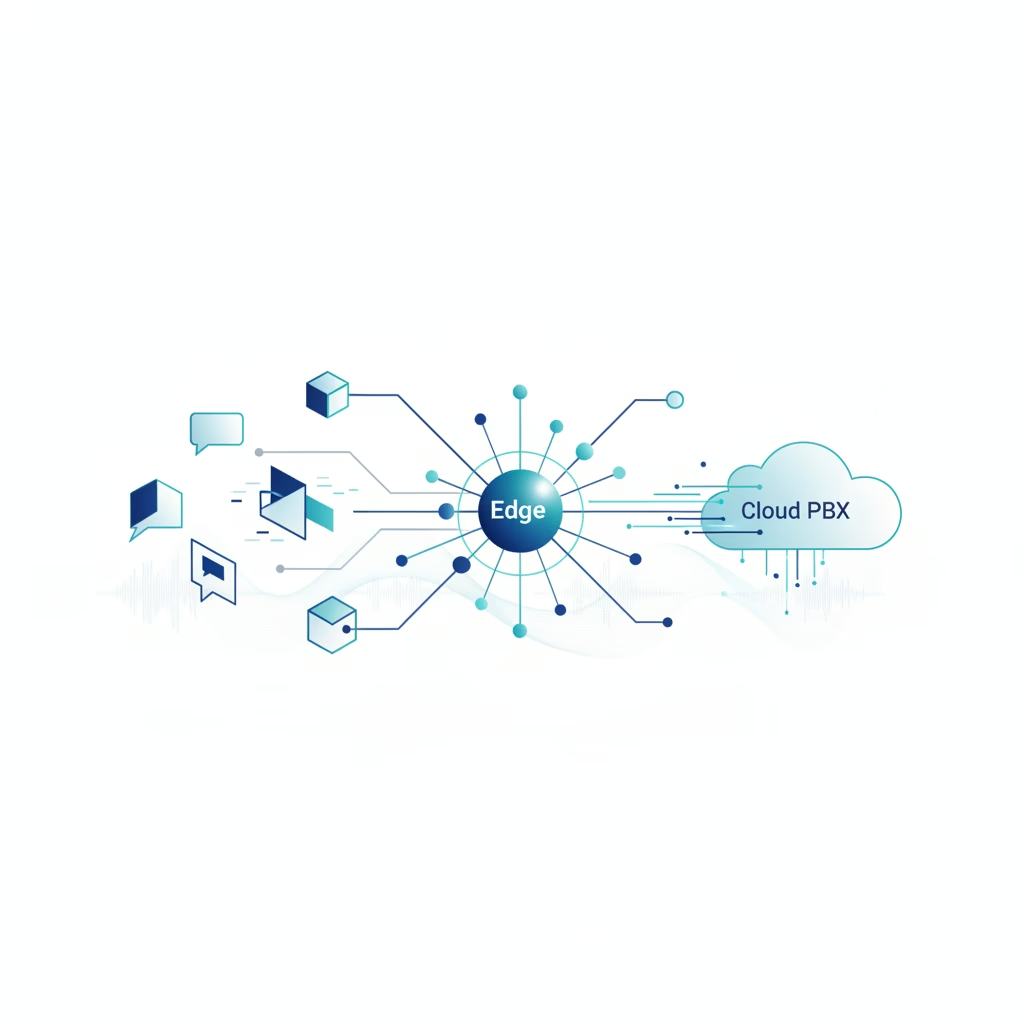
For voice applications, edge computing essentially creates a localised processing environment. Instead of a call signal having to traverse a wide area network (WAN) to a distant server and then back, it can be processed by an 'edge node' within your regional network or even on-premises. This fundamental shift in architecture yields immediate and tangible benefits for business voice communications.
Consider a multi-national European enterprise: a call initiated in Berlin no longer needs to travel to a cloud server in Dublin to be processed before reaching its destination in Paris. With edge computing, that processing can occur at a regional hub, drastically cutting down on travel time for data packets and ensuring a more fluid conversation.
Key Benefits for European Businesses
Adopting an edge computing strategy for voice applications offers several critical advantages that resonate strongly with European business priorities:
Improved Call Quality and Reliability: The most immediate benefit is reduced latency. Less delay means more natural conversations, fewer interruptions, and higher voice fidelity. This is crucial for sales calls, customer support interactions, and critical internal communications. By distributing processing, edge computing also enhances reliability; if one central cloud region experiences an issue, local edge nodes can continue to operate, ensuring business continuity.
Enhanced Security and Data Sovereignty: For European organisations, data privacy and sovereignty are not just best practices – they are legal requirements under regulations like the General Data Protection Regulation (GDPR). Edge computing allows sensitive voice data to be processed and, where appropriate, stored closer to its origin, reducing its journey across borders and potentially multiple jurisdictions. This can simplify compliance efforts and provide greater assurance regarding data locality and control, which is a major concern for many European businesses.
Optimised Bandwidth and Cost Efficiency: Sending all raw voice data to a central cloud for processing can consume significant bandwidth, especially for large organisations. Edge computing enables pre-processing and aggregation of data locally, meaning only processed or essential information needs to be sent to the central cloud. This can lead to lower bandwidth costs and more efficient network utilisation, a valuable consideration for businesses managing complex IT infrastructures across various European sites.
Faster Deployment of AI and Analytics: Voice applications are increasingly incorporating AI for features like sentiment analysis, transcription, and virtual assistants. Running these AI models at the edge means real-time processing without network bottlenecks, leading to immediate insights and quicker responses, essential for dynamic customer service environments.
Real-World European Applications
Edge computing is not just a theoretical concept; it's being deployed in practical scenarios across Europe:
- Manufacturing Plants: In large industrial complexes, on-site edge devices can manage internal communications, intercom systems, and even integrate voice commands for machinery, ensuring ultra-low latency critical for operational safety and efficiency.
- Retail Chains: For organisations with numerous retail outlets, edge nodes in each store can handle local VoIP traffic, powering point-of-sale communications, local customer service lines, and secure inter-store calls without relying heavily on a centralised system for every voice packet.
- Remote Workforces and Branch Offices: With the rise of hybrid work models, edge computing can significantly enhance the experience for remote teams by providing a more stable and high-quality connection to the organisation's central communications system, regardless of their internet connection quality.
Integrating Edge with Your Cloud PBX Solution
For businesses already leveraging or considering a Cloud PBX solution like TheVoĉo's, edge computing isn't a replacement but a powerful enhancement. The Voĉo's robust cloud infrastructure provides the scalability, feature richness, and global reach that modern businesses demand. By strategically integrating edge components, we can further optimise performance for specific use cases or geographies.
This hybrid approach means your organisation benefits from the best of both worlds: the vast capabilities and redundancy of a central cloud combined with the speed and localised processing power of the edge. It allows for intelligent routing, local failover, and reduced reliance on external networks for day-to-day internal voice operations, all while maintaining the flexibility and management ease of a cloud-first system.
Conclusion: The Future of Business Voice is Hybrid
Edge computing is set to redefine expectations for business voice applications, particularly for European organisations with their unique demands for speed, reliability, and data compliance. By bringing processing closer to the source, businesses can unlock unparalleled call quality, bolster data security posture in line with GDPR, and achieve greater operational efficiency.
As the telecommunications landscape evolves, a hybrid cloud-edge strategy will become the gold standard, ensuring that your business communications are not just robust and feature-rich, but also incredibly fast, secure, and compliant. Ready to explore how edge computing can elevate your organisation's voice capabilities? Contact TheVoĉo today to discuss how our solutions can provide a competitive edge for your business.